Do Listicles and Comparison Posts Still Matter for SEO?
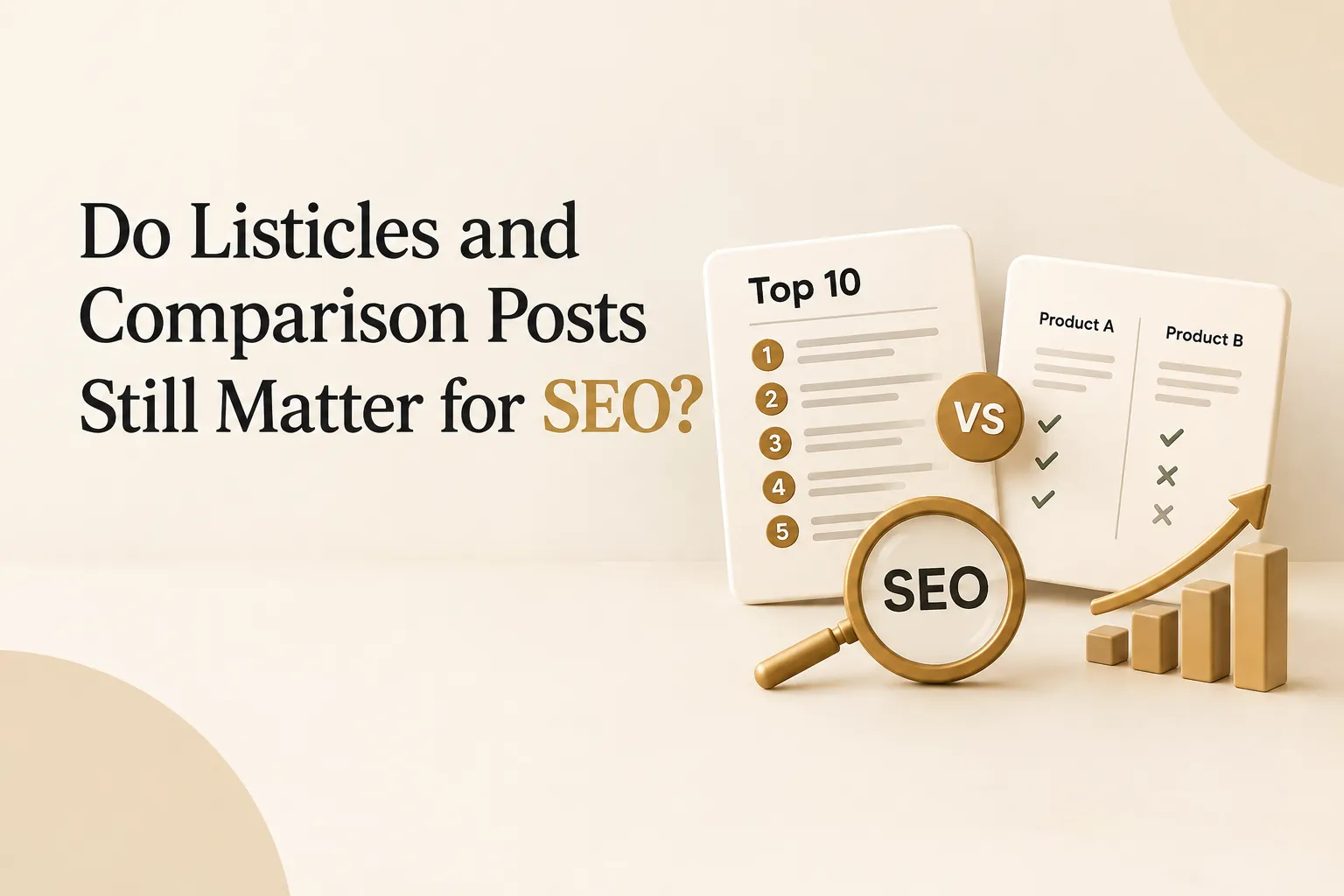
Yes, even in 2026, listicles and comparison posts remain important for SEO, but it all depends on how successfully the questions of users are answered. Search engines have never stopped valuing valuable and relevant information, while AI Overviews and AI search have changed the way of people finding content. Creation of any numbered list or comparison of products without giving some valuable information is not a proper strategy anymore.
The content should be helpful for people in understanding the topic, in evaluating existing choices and making decisions. Being a business owner, a marketer, or an SEO expert, you will have a chance to draw appropriate visitors and gain authority. Listicles and comparison posts are helpful and accurate because they allow meeting the expectations of the users.
What Are Listicles and Comparison Posts in SEO?
Listicles and comparison posts are useful content formats to help provide structure to your information. They can be used to help your readers find answers quickly. Whilst they can both help with SEO, it depends on what your audience is looking for when searching that will determine which type you should use.
What is a Listicle?
The listicle provides information in a list format. Examples could be "10 ways to improve your website speed", "7 SEO tools for small businesses" and "8 mistakes to avoid when doing content marketing." The listicle format helps if you’re looking to provide actionable tips, suggestions, examples or a list of ideas for your readers.
Each point should provide its own benefit and reasons why. For example, a listicle about improving your website may include points about compressing images, using browser caching and removing unnecessary javascript. A good listicle will provide useful information about why the suggestions are good.
What is a Comparison Post?
A comparison post compares two or more products/services/tools/strategies. It helps your readers understand how different options are and which would be best for them. Some examples could be "Semrush or Ahrefs", "Shopify or WooCommerce" and "In house SEO or outsourced SEO."
A good comparison will have consistent criteria throughout – feature, cost, ease of use, cons and when to use. The comparison should give an explanation about the pros and cons of each of the options. There shouldn’t be any untrue claims. A comparison post helps to explain to your readers the compromises that need to be made when choosing between the options.
Do Listicles and Comparison Posts Still Matter for SEO in 2026?
Certainly, both formats are equally valid, since people are always searching for tips, answers, and comparisons. However, search engines don't give any preference to the content simply because it is presented in the form of a list or a table. A short article that contains something unique can be better than a long one, repeating information from other sources.
The guidelines for making people-first content by Google focus on the creation of useful content for readers instead of making a page for ranking purposes. AI Overviews and other AI-powered search features have also impacted the way users get information. Some search queries can be answered right within search results and influence click-through rates of websites. The best solution is to write content that offers more than just a summary.
How Search Engines Evaluate These Content Formats
There are several ways by which the search engines evaluate the relevance and usefulness of the web pages. The pages are evaluated based on how relevant they are to the queries, quality of information provided in them and how useful they are. It should be noted that there is no certain ranking trick that would guarantee success of the listicles and comparison pieces.
For instance, while compiling the top 10 SEO tools list, one should tell how each of them functions and for whom they are intended as well as limitations of each one. The same is true for comparison articles where the differences between various options should be described.
The Importance of Helpful Content and AI Search
Helpful content contains the answers to all the questions, supports significant claims and provides the readers with all the necessary information regarding the topic. Even though the AI Overviews usually summarize information found in different sources, the detailed explanation, original research and comparison still give a reason to look for a website.
There is no recipe that guarantees the appearance in the AI generated answers.
SEO Benefits of Listicles and Comparison Posts
Listicles and comparison articles can be used for certain SEO goals. They can help your website answer questions around informational and commercial search intent, provide clarity over complex topics and help connect your audience to resources. However the quality of your content, competition for your chosen keyword and what your audience is looking for will all play a role.
Targeting Search Intent and Improving Readability
Listicles can be good for informational searches and comparisons can be used for questions like ‘how to improve website security’ and best practice for technical SEO. This will help you decide which of the two to go with based on what your audience would expect.
Both comparison and listicle articles can be made easy to read. This can be done using clear headings, short paragraphs, descriptive titles and relevant tables. This means your audience can quickly find the information they need. Whilst good formatting isn’t the most important part of your article having useful information is.
Backlinks and Conversion
If you carry out original research, detailed analysis and include examples, your content could be seen as valuable enough for other websites to link to. Comparisons can be very useful if you have evidence to back up your findings. This can provide useful insights into which may be more useful than just listing features. Including relevant internal links can help connect your audience to helpful guides.
These articles can help bring in traffic at various stages of the buying process. A listicle can be used to show your potential customers what options they have available to them. Comparison articles can also help them make their decision. Once they’ve expressed an interest in your products/services they can be directed to your product/service page or contact form. Using these articles can help bring targeted traffic to your site who will take action.
Listicles vs. Comparison Posts: Which Is Better for SEO?
Neither are perfect and you will need to decide which is best based on your target keyword, the reader’s intent and what information you need to provide. If you don’t choose the right one then your content will lack the information your readers were looking for.
When to Use A Listicle
If your content is providing a list of tips, ideas, tools, examples or recommendations then you should use a listicle. Topics like ‘10 Ways to Improve Website Conversion Rates’ or ‘7 Technical SEO Issues to Look For During An Audit’ would be great for using a listicle. Each point should provide unique insights into the main topic of your article.
When to Use A Comparison Post
If your readers need to know the differences between two options to make a decision then a comparison post would be best for your article. For instance, Shopify vs. WooCommerce or Semrush vs. Ahrefs might be used. The differences between these tools should be listed, criteria that were used for the evaluation provided and examples of situations when it would be better to choose one of them should be given.
Choosing the Research Topic
It is essential to verify the search results of the required keyword to determine if it is a list, a comparison, a guide or a review that users are looking for. In addition, it is crucial to analyze the information available from other websites in order to identify some gaps. Do you have enough reliable information to provide? If you’re doing a comparison post you need to have fair criteria. If you’re doing a listicle then your recommendations need to be unique and useful. Don’t just copy the structure of other pages – choose the one that will best answer the search query.
How to Create SEO-Friendly Listicles and Comparison Posts
To create effective content you need to have a clear purpose behind it. Know what your audience will want to know and make sure to structure your content well. Each section should add value to your article.
Make sure to include your primary keyword in your title and key sections. If appropriate add in secondary keywords. Review your current content to see if you can improve any of the content to provide more value.
Include unique insight, practical examples and factual information. Include descriptive headings, interlinking to relevant topics, referencing credible sources and meta titles and descriptions. Add in images, screenshots and comparison tables.
The best content will be optimised for search engines and provides value. Make sure to include accurate details around your products features, price and any other dynamic information. Justify your key recommendations.
Common mistakes to avoid
Over optimisation. You may include too many keywords which can make your content feel unnatural. You may find that you have too many repeated phrases throughout your headings and paragraphs. Low quality content. Your content may lack quality and become repetitive. Your points may be very similar.
Recommendations may be biased. Ensure that you are using the same criteria to compare your options. Separate your facts from opinions and include any limitations each option has. If there are any conflicts of interest when making recommendations then be transparent.
Out of date content. This is a common issue with content around software, pricing and features. Make sure to keep your key pages updated. Focus on producing accurate, fair and helpful content rather than lots of keywords.
How to measure the SEO of your Listicle & Comparison Posts
Use Google Search Console to track impressions, clicks, click through rate, average position and the searches. Use Google Analytics 4 to track how engaging your audience are. Don’t look at a short time frame but a suitable time frame.
Look at your conversions. Depending on your business this could be sales, form fills, demo requests or quality. Even though your comparison article may drive traffic to your site, they may return to your service page and make an enquiry. Focus on tracking your conversions from relevant traffic.
Suggestions for best practice
All the content you create should be founded on your own experiences, research and factual data. Make sure that when comparing products/services you make it clear how you compare them. Do not hide restrictions if any exist. If you cannot test products yourself, make it clear how you arrived at your conclusion. Keep all the critical data up to date.
Make your content readable. Use descriptive headings, clear explanations and examples. Google follows E-E-A-T principles (Experience, Expertise, Authoritativeness & Trustworthiness) to show what they think is important. Try not to concentrate on your score but rather to make content trustful and human readable.
Conclusion – Are Listicles & Comparison Posts good for SEO?
Yes, Listicles and Comparison Posts are still a great way to utilise SEO in 2026 as long as your content is relevant, factual and provides value.
Use listicles to provide tips, tools and recommendations. Use comparison posts to compare different options. Ensure your content is meeting the search intent, adding unique insight and providing accurate information. Track your success based on organic visibility and conversions. Content that helps your audience will always have a strong foundation to provide long term visibility in search and grow your business.