Google Users Are Still There - so Why Is Organic Traffic Falling?
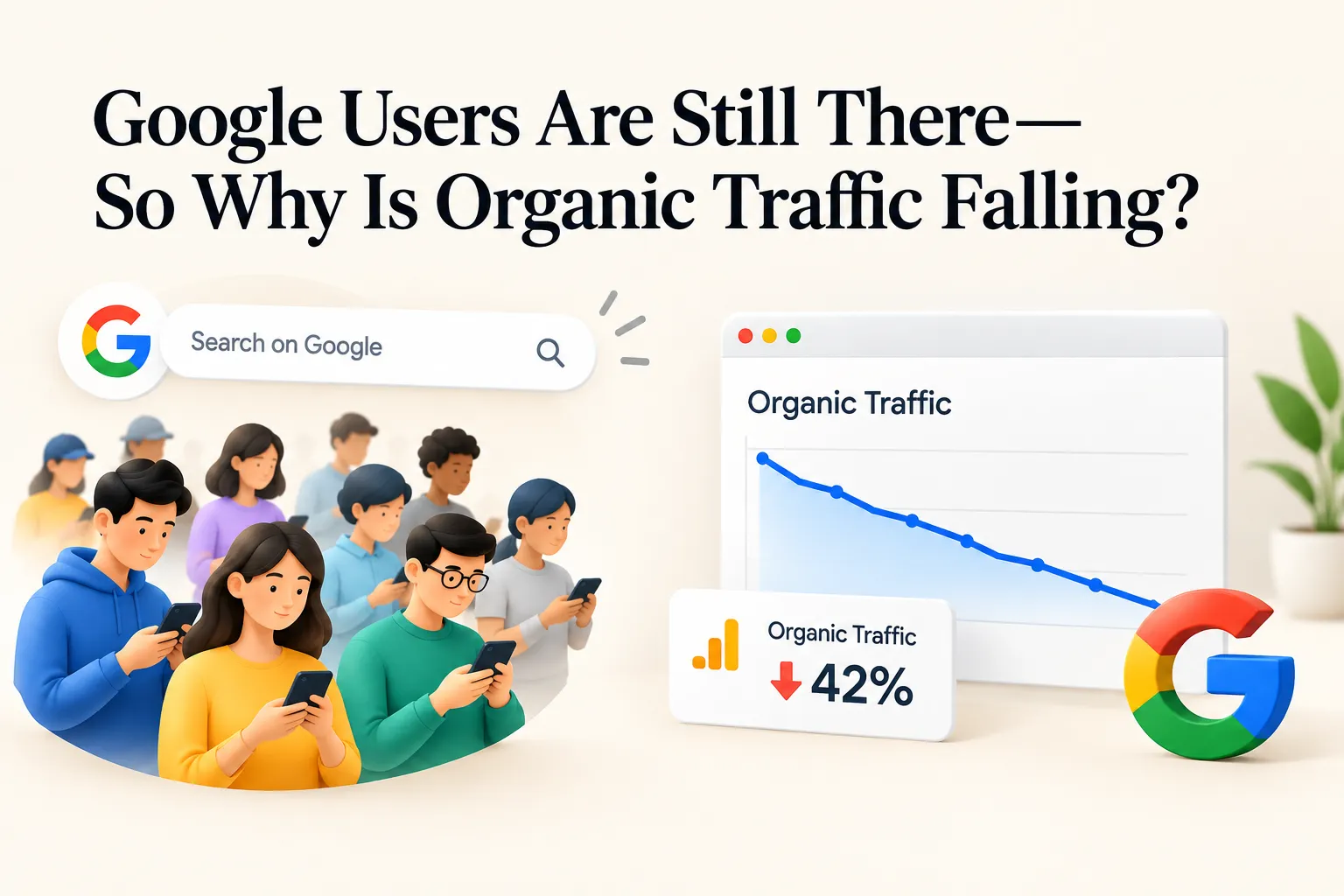
Organic traffic can fall even when Google continues to have a large and active audience. The reason is simple: users may still use Google, but they are changing how they search, where they find answers, and when they decide to click through to a website. For businesses, this creates a new challenge. A strong ranking or stable audience size does not always lead to the same level of organic traffic.
This change matters because search is no longer limited to typing a query into Google, choosing a result, and visiting a website. Users can now move between Google, ChatGPT, AI-powered search experiences, social platforms, and brand websites during a single customer journey. As an SEO expert, understanding this changing behaviour is becoming just as important as improving rankings.
The bottom line is that Google users have not necessarily disappeared. However, the path between a search and a website visit is becoming less direct.
Google Traffic Is Changing, Not Necessarily Disappearing
A common mistake is to assume that declining organic clicks automatically mean fewer people are interested in Google Search. In reality, audience size, search activity, and website traffic are three different things.
A person can continue using Google every day while making fewer traditional searches. The same person may use an AI platform for research, return to Google to compare options, and then visit a website only when they are ready to take action. This means user behaviour can change significantly without Google completely losing the user.
For website owners, this creates an important measurement problem. You may see impressions remain stable while clicks fall. You may see rankings improve while traffic declines. You may even see branded searches increase while non-branded traffic becomes less predictable.
These changes do not always indicate that your SEO strategy has failed. They may indicate that the search journey itself is changing.
The key point is that audience presence does not automatically equal website traffic.
One User Can Use Google and AI Platforms Together
The idea that users must choose between Google and ChatGPT is becoming less accurate. Many people use both platforms for different purposes.
A user may ask an AI platform for an explanation, a comparison, or ideas. They may then use Google to verify information, compare brands, find reviews, check prices, or search for a specific company.
A modern customer journey can look like this:
- A user discovers a topic through an AI platform.
- The user learns about possible solutions.
- The user discovers a brand name or product.
- The user searches that brand on Google.
- The user visits the website before making a decision.
From an analytics perspective, the final Google search may receive all the visible credit for the visit. However, the original discovery may have happened somewhere else.
This is why businesses should avoid looking at each platform in isolation. Google can still play an important role in the journey even when AI platforms handle some of the earlier research stages.
The same user can move between multiple platforms without considering them competitors in their own mind. They simply use the tool that feels most useful at that moment.
Why Search Queries Can Decline Without Google Losing Its Audience
The number of people using a platform and the number of searches performed on that platform are not the same metric.
Imagine a user who previously searched Google five times to research a topic. They may now ask an AI platform one detailed question and receive a structured response covering several smaller questions.
In this situation, Google may not lose the user completely. However, it may receive fewer individual queries from that person.
This creates a major shift in how businesses should interpret search data.
Traditional SEO reporting often focuses heavily on:
- Search impressions
- Clicks
- Average position
- Keyword rankings
- Organic sessions
These metrics are still valuable. However, they no longer explain the complete discovery journey.
A decline in search queries does not always mean that interest in a topic has disappeared. Users may simply be finding information through a different format or platform before returning to Google later in their journey.
For example, a person may use AI to understand "how SEO works" and later search Google for "best SEO consultant near me." The informational query may move away from traditional search, while the commercial or decision-focused query remains highly valuable.
This means businesses should pay closer attention to the types of queries that generate traffic, leads, and conversions.
The Bigger Problem for Websites Is Fewer Clicks
The biggest concern for many website owners is not whether people continue using Google. The bigger question is whether users still need to click on external websites.
Search results are becoming more answer-focused. AI-generated responses, featured information, knowledge panels, videos, maps, product results, and other search features can help users find information without visiting as many websites.
This can create a situation where your content appears in search results and receives visibility, but fewer users click through.
More visibility does not always mean more traffic.
A website may rank well and generate a large number of impressions while receiving fewer clicks than it would have received in a more traditional search environment. This is especially important for informational content where users can receive a quick answer directly on the search platform.
However, this does not mean websites are becoming unnecessary.
Websites remain essential for deeper information, services, trust, product details, comparisons, demonstrations, lead generation, and conversions. The challenge is that businesses may need to create stronger reasons for users to visit.
Your content should not only answer the basic question. It should provide additional value that encourages the user to continue exploring.
Why Google Search Console Does Not Show the Complete Journey
Google Search Console is an important tool, but it only shows part of the customer journey. It can help you understand how users discover your website through Google Search. It can show impressions, clicks, queries, and search performance. However, it cannot always explain what happened before the user searched Google.
Consider this journey:
User asks an AI platform a question → discovers your business → remembers your brand → searches your brand on Google → visits your website
Google Search Console may show the branded search and the website click. However, it may not show that an AI interaction influenced the user's original discovery.
This creates an attribution gap.
Businesses that only analyse the final source of traffic may misunderstand how people actually discover their brand.
The problem becomes even more complex when users move between devices. A person may discover a company through AI on a mobile phone and later search for the company directly on a laptop.
From a reporting perspective, the final website visit may appear as direct traffic or branded organic traffic. The earlier discovery process may remain invisible.
This is why modern SEO measurement requires more than looking at one dashboard.
The SEO Metrics That Matter in the AI Search Era
Rankings and clicks remain important, but businesses should measure performance across a wider set of signals.
Organic clicks can show whether Google Search is sending visitors to your website. However, clicks alone cannot explain brand discovery, assisted journeys, or users who return later through another channel.
A stronger measurement approach should consider the relationship between visibility and business outcomes.
Important metrics include:
- Organic clicks and impressions
- Branded search growth
- Non-branded search visibility
- Organic conversion rate
- Leads and revenue from organic traffic
- Direct traffic trends
- Referral traffic from AI platforms
- Brand mentions across relevant platforms
- AI citations where measurable
- Assisted conversions
- Returning visitors
- Growth in branded queries
These metrics help businesses understand whether reduced clicks represent a real decline in demand or simply a change in user behaviour.
For example, organic traffic may decline slightly while branded searches and conversion rates increase. In that situation, the business may be reaching fewer casual visitors but attracting more qualified users.
This is why traffic should never be measured without considering quality.
Why Branded Search May Become More Important
AI platforms can introduce users to businesses, products, experts, and solutions that they did not previously know.
When users later want to verify a recommendation or learn more about a company, they may search the brand name on Google.
This creates an indirect connection between AI visibility and branded search demand.
A person may not click your website directly from an AI platform. Instead, they may remember your name and search for you later.
Businesses should therefore monitor whether brand awareness is increasing across search.
A growing number of branded searches can indicate that more people are discovering and remembering the business. It can also signal that users are actively moving from awareness to evaluation.
Of course, branded search growth should not be interpreted alone. Businesses should also analyse conversions, engagement, and user behaviour to understand whether increased awareness is creating real business value.
The goal is not simply to become visible everywhere. The goal is to become discoverable at the moments that influence decisions.
Rankings Alone Are No Longer Enough
Ranking reports are useful, but they do not tell the complete story.
A keyword can rank in the first position and still receive fewer clicks if users get enough information before reaching the organic results. On the other hand, a lower-ranking page can generate highly valuable traffic if the user has strong commercial intent.
This means SEO success should increasingly be connected to the complete journey.
Instead of asking only:
What position does this keyword have?
Businesses should also ask:
Who is searching for it?
What does the user want to achieve?
What information do they receive before clicking?
Does the visit lead to meaningful engagement or conversion?
These questions help create a more realistic view of search performance.
The future of SEO measurement will depend less on a single number and more on understanding how multiple signals work together.
How Businesses Should Adapt Their SEO Strategy
Businesses should not respond to AI-driven search changes by abandoning Google. Google remains an important discovery and decision-making platform for many users.
Instead, businesses should build a broader visibility strategy.
First, focus on creating genuinely useful content. Content should answer the user's question clearly while offering insights, examples, experience, or depth that cannot easily be replaced by a short summary.
Second, strengthen your brand. Users are more likely to search for and trust businesses they recognise.
Third, focus on commercial value. Informational traffic is useful, but the ability to convert relevant visitors into leads or customers is becoming increasingly important.
Fourth, monitor multiple discovery channels. Do not assume that the last-click source explains the complete customer journey.
Finally, connect SEO reporting with business results. Rankings are useful indicators, but leads, enquiries, sales, engagement, and brand growth provide a clearer picture of performance.
The Future of SEO Is Multi-Platform Visibility
Search is no longer a simple Google versus AI conversation.
Users increasingly move between search engines, AI platforms, social networks, video platforms, review websites, and business websites. Each platform can play a different role in the customer journey.
AI may help users discover ideas. Google may help them verify options. Reviews may build trust. A website may provide the information required to make a final decision.
Businesses that focus on only one platform may miss important parts of this journey.
The stronger approach is to think about visibility as a connected system:
AI Discovery + Google Search + Brand Awareness + Website Trust + Conversion
Each stage supports the next.
This does not reduce the importance of SEO. It changes the way SEO should be measured and managed.
Final Thoughts
Google users are still there, but the journey from search to website is becoming more complex. Users can receive answers without clicking, discover brands through AI, return to Google for verification, and visit websites later through branded or direct searches.
For businesses, the answer is not to focus only on declining clicks or changing rankings. The better approach is to understand the complete discovery journey and measure how search visibility contributes to brand growth and conversions.
As search behaviour continues to evolve, businesses need a broader strategy that connects Google visibility, AI discovery, brand awareness, and website performance. Working with an experienced SEO expert can help businesses interpret these changes, identify the metrics that truly matter, and build an SEO strategy around real user behaviour rather than relying on rankings and clicks alone.