On-Page vs Off-Page SEO: What's the Difference?
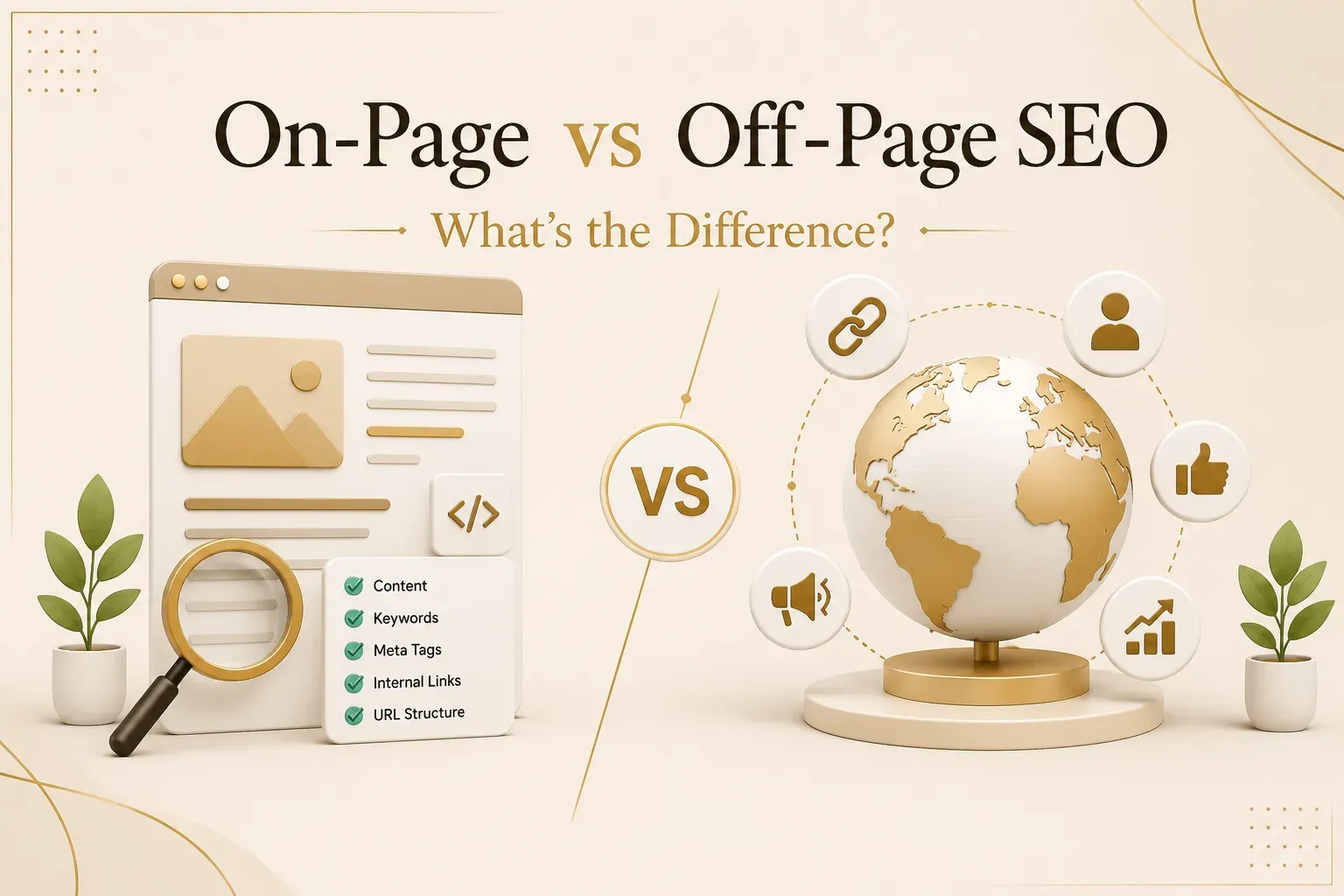
Ranking on Google depends on two separate but connected systems: on-page SEO and off-page SEO. On-page SEO covers everything you control directly on your website, such as content, HTML tags, and site structure. Off-page SEO covers everything that happens away from your website, such as backlinks, brand mentions, and reviews. A website that ignores either one will hit a growth ceiling no matter how much budget gets thrown at it. Anyone comparing SEO services in Delhi should understand this split before signing a contract, because it changes how you judge an agency's proposed strategy and timeline.
This article explains both concepts individually, shows where they overlap, and gives you a practical framework for deciding which one deserves attention first.
Defining On-Page SEO
On-page SEO means optimizing elements that live directly on a webpage so search engines and visitors can understand it faster. This covers the written content, title tags, header structure, internal links, URL formatting, and page speed. Every one of these elements sits inside your CMS, which means you can change and republish them the same day you spot a problem.
A search engine crawler scans a page and tries to answer one question: does this content match what the searcher is looking for? Title tags, header tags, and body copy all feed into that judgment. A page titled "Best Running Shoes for Flat Feet" that actually opens with three paragraphs about the history of athletic footwear will confuse both the crawler and the reader, and rankings will suffer as a result.
Speed and structure matter just as much as wording. A visitor who lands on a page that takes eight seconds to load will leave before reading a single sentence, regardless of how well the copy was written. Google's Core Web Vitals report, layout shift metrics, and mobile usability checks all factor into how a page ranks once relevance is established.
Elements that fall under on-page SEO include:
- Title tags and meta descriptions written for both clarity and click-through rate
- H1, H2, and H3 tags that break content into scannable sections
- Natural keyword placement inside the opening paragraph and throughout the body
- Internal links connecting related pages within the same domain
- Compressed images with descriptive alt attributes
- Clean, readable URL slugs
- Mobile-friendly layouts and fast page load times
- Structured data markup that enables rich results in search listings
Content depth is the deciding factor behind most on-page rankings today. Google's quality guidelines, built around Experience, Expertise, Authoritativeness, and Trustworthiness (E-E-A-T), reward pages that answer a query thoroughly and penalize pages that repeat generic information already available everywhere else. A 600-word article stuffed with keywords will rarely outperform a 1,200-word article that actually solves the reader's problem with specific, accurate detail.
Technical health supports everything above it. Broken internal links, duplicate title tags, and slow server response times quietly cap how high a page can climb, even when the writing itself is excellent. Regular audits using tools such as Google Search Console or Screaming Frog catch these issues before they compound into a bigger ranking problem. Businesses evaluating SEO services in Delhi should confirm that a technical audit is part of the initial engagement, not an optional add-on billed later.
Defining Off-Page SEO
Off-page SEO includes every action taken outside your website that builds its authority and reputation with search engines. Backlinks sit at the center of this discipline. When another website links to yours, it functions as a signal of trust, telling Google that people outside your organization find your content valuable enough to reference.
Unlike on-page work, off-page SEO depends on decisions made by other people. You cannot force a journalist to mention your brand or force a blogger to link to your article. You can only produce content strong enough, or build relationships genuine enough, that other sites choose to link back on their own.
Link building anchors most off-page strategies, but it is not the only lever available. Mentions of your brand across news sites, forums, and social platforms contribute to authority even without a clickable link attached. Positive reviews on Google Business Profile, active engagement on LinkedIn or Instagram, and appearances in industry roundups all add to the same trust signal search engines track over time.
Components typically grouped under off-page SEO include:
- Backlinks earned from relevant, authoritative websites
- Guest articles published on established industry publications
- Digital PR campaigns and journalist outreach
- Social media activity tied to brand recognition
- Customer reviews across Google, Trustpilot, or industry-specific platforms
- Local business directory listings and citations
- Community participation on platforms like Reddit or Quora
Quality decides the value of a backlink far more than the total count does. One link from a nationally recognized publication carries more weight than dozens of links from unrelated, low-authority directories. Google's algorithm updates, including the Penguin update, specifically target manipulative link networks, which is why buying bulk backlinks tends to trigger penalties rather than ranking improvements.
Local SEO belongs firmly inside the off-page category for any business tied to a physical location or service area. A verified Google Business Profile, consistent name-address-phone details across directories, and a steady stream of customer reviews all shape how a business appears in local map results. For companies researching SEO services in Delhi, this local layer often matters more than broad national keyword rankings, since most customers search with location intent already built into the query.
Core Differences Between On-Page and Off-Page SEO
The simplest way to separate these two disciplines is by asking where the work happens and who controls it. On-page SEO happens inside your website, under your direct control. Off-page SEO happens outside your website, shaped by external parties choosing to link, mention, or review your brand.
Both disciplines aim at the same outcome, but they answer different questions for the search engine. On-page work answers, "Is this page relevant to the search query?" Off-page work answers, "Does the broader internet trust this website?" A page needs a strong answer to both questions before it can compete for a top ranking in a competitive niche.
A direct comparison looks like this:
- Location: on-page changes exist within your own site; off-page signals come from external sources
- Control: on-page is fully within your hands; off-page depends on third parties choosing to act
- Speed of impact: on-page edits can influence rankings within days; off-page authority typically builds over several months
- Core focus: on-page centers on content quality and technical structure; off-page centers on trust and reputation
- Tracking method: on-page progress is measured through rankings and crawl reports; off-page progress is measured through referring domains and domain authority scores
Neither discipline can substitute for the other. A flawlessly optimized page with zero external links will struggle against established competitors in any competitive industry, since search engines have no outside confirmation of its credibility. On the other side, a page loaded with backlinks but filled with shallow, repetitive content will eventually slide down the rankings once Google's ranking systems evaluate the actual substance of the page.
The budget conversation often changes once this distinction is clear. SEO expert offering SEO services in Delhi typically price on-page audits and content work separately from ongoing off-page outreach, since the two require different skill sets and timelines. On-page work is usually a fixed-scope project with a defined deliverable, while off-page work runs as a continuous retainer because authority building never truly finishes.
Why On-Page and Off-Page SEO Must Work Together
Search engines do not evaluate websites through a simple checklist; they cross-reference content relevance against domain trust before deciding where a page belongs in the results. A strategy built around only one side of this equation creates an imbalance that eventually limits growth, no matter how much effort goes into that single side.
Picture a newly launched website in a crowded industry. Even with perfect meta tags, quick load times, and well-researched content, it will rank behind older competitors until it accumulates backlinks and genuine brand recognition. Off-page work is what builds that credibility over time, since search engines treat domain age and external validation as trust indicators.
The opposite scenario plays out just as often. A site with hundreds of backlinks but weak, thin content will see returns shrink as Google's ranking systems place growing weight on user experience signals like dwell time, bounce rate, and content depth. The Helpful Content system specifically targets pages that fail to deliver real value, regardless of how many external sites link to them.
A balanced approach generally follows this order: resolve technical and on-page issues first, publish content that genuinely solves reader problems, then invest in off-page authority through outreach and relationship-based link building. Following this sequence ensures the authority earned externally gets directed toward pages capable of converting that traffic into actual business results.
Deciding Which Strategy to Prioritize First
Business owners frequently ask whether on-page or off-page work deserves the first round of budget, especially when resources are limited. The right answer depends entirely on where a website currently stands. Sites with technical errors, thin content, or poor mobile experience should fix on-page issues first. Sites with strong content but low visibility should shift budget toward off-page authority building.
I'm Vipul Rajput, and across more than 8 years in this field, I've worked on 100+ SEO projects spanning ecommerce, local business, and B2B websites. Certifications from SEMrush, HubSpot, and Google Analytics have shaped how I evaluate technical SEO alongside content and authority strategy for every client engagement. Business owners comparing SEO services should ask any shortlisted agency how they sequence these two disciplines, since a strategy tilted too far toward one side rarely holds up over the long run.
When evaluating a potential SEO partner, useful questions include:
- How do they audit existing technical and on-page issues before starting work?
- What is their process for earning backlinks without relying on link farms or paid schemes?
- How do they measure progress across both content performance and authority metrics?
- Do they provide transparent monthly reporting on rankings, organic traffic, and referring domains?
A dependable agency explains both sides honestly instead of overselling one tactic as a complete fix. SEO rarely produces overnight results; sustainable rankings build gradually as on-page improvements and off-page authority compound across several months of consistent work.
Mistakes Businesses Commonly Make With Both Strategies
Many websites underperform not from a lack of effort, but from effort aimed in the wrong direction. One frequent mistake treats keyword repetition as the main ranking factor while ignoring whether the content actually satisfies the searcher's intent. Modern ranking systems weigh whether a page answers a query completely, not how many times a specific phrase appears on it.
Chasing backlink volume instead of backlink quality causes similar damage. Some businesses purchase bulk link packages expecting quick ranking jumps, only to watch traffic drop once Google's algorithm flags the unnatural pattern behind those links. Recovering from a manual action penalty tied to a bad link scheme often takes longer than building authority correctly from day one.
Neglecting technical SEO creates a third common gap. A business might invest heavily in content and outreach while ignoring page speed, broken links, or missing schema markup, all of which quietly cap how far that content and authority can carry the site. This is one reason experienced providers of SEO services in Delhi run a technical audit before recommending any content or link-building work.
Frequent mistakes worth avoiding include:
- Repeating keywords unnaturally instead of writing for the searcher's actual intent
- Purchasing backlinks from irrelevant or low-quality websites
- Overlooking mobile speed and Core Web Vitals scores
- Publishing new content without linking it to related existing pages
- Skipping local citations for businesses that depend on geography-specific searches
Avoiding these mistakes requires continuous monitoring rather than a one-time setup. SEO functions as an ongoing process of refining content, earning trust, and adjusting to algorithm updates that regularly reshape ranking criteria across nearly every industry.
Tools That Track On-Page and Off-Page Performance
Measuring progress requires different tools for each discipline, since they track entirely different signals. On-page performance is monitored through crawl data, page speed scores, and keyword rankings, while off-page performance is monitored through referring domains, domain authority, and brand mention volume. Relying on a single dashboard for both often hides problems that need separate attention.
Google Search Console remains the starting point for on-page monitoring. It flags indexing errors, mobile usability issues, and shows which queries actually bring traffic to a page. Pairing it with PageSpeed Insights reveals load time bottlenecks that a written audit alone would miss. For content-specific tracking, tools like SEMrush or Ahrefs show keyword position changes over time and highlight pages losing visibility before the drop becomes severe.
Off-page tracking relies more heavily on backlink analysis platforms. Ahrefs and SEMrush both maintain databases of referring domains, letting site owners see which links are new, which have been removed, and which competitors are earning links that your site is missing. Google Alerts and similar mention-tracking tools catch brand references that never carry a link, which still matter for overall reputation signals search engines pick up on indirectly.
Tools commonly used for tracking both disciplines include:
- Google Search Console for indexing, crawl errors, and query-level performance
- Google PageSpeed Insights and Core Web Vitals reports for technical speed data
- SEMrush or Ahrefs for keyword rankings and backlink profile analysis
- Google Business Profile Insights for local search visibility
- Google Alerts or Mention for tracking unlinked brand references
Reviewing these metrics on a monthly basis, rather than only at the start of a project, catches ranking drops early enough to fix before they compound into a bigger recovery project later.
Who Benefits Most From a Combined SEO Strategy
Anyone weighing different SEO services in Delhi will notice quickly that not every website needs the same balance of on-page and off-page investment. A brand-new local business with almost no online presence benefits most from local citations, a verified Google Business Profile, and a handful of relevant backlinks alongside basic on-page fixes. An established ecommerce site with years of content usually needs deeper on-page work, since thin product descriptions and duplicate category pages tend to accumulate over time.
Service-based businesses searching for growth through SEO services in Delhi often fall somewhere in between. They typically have a functional website with reasonable content but limited backlinks and inconsistent local citations, which means off-page work delivers faster visible gains once basic on-page issues are resolved. Understanding where your own website falls in this spectrum prevents wasted budget on the wrong priority.
Conclusion
On-page SEO and off-page SEO are not rival strategies competing for budget; they are two halves of the same ranking system working toward one outcome. On-page work makes a website relevant, fast, and easy for both crawlers and readers to understand. Off-page work builds the trust and authority that convince search engines a site deserves visibility in the first place. Neglecting either side leaves a visible gap in organic performance that the other side cannot fully close on its own.
Treat both disciplines as ongoing priorities instead of a one-time setup. Audit your technical and content foundation on a regular schedule, then invest steadily in ethical link building and brand visibility across relevant platforms. This combined approach compounds month over month, producing rankings that hold steady even as search algorithms continue to evolve. Anyone comparing providers of Best SEO services in Delhi should choose a partner who explains this balance clearly, since that balance ultimately decides whether a website ranksand keeps ranking over the long term.