How GEO Changes Everything for Delhi Businesses
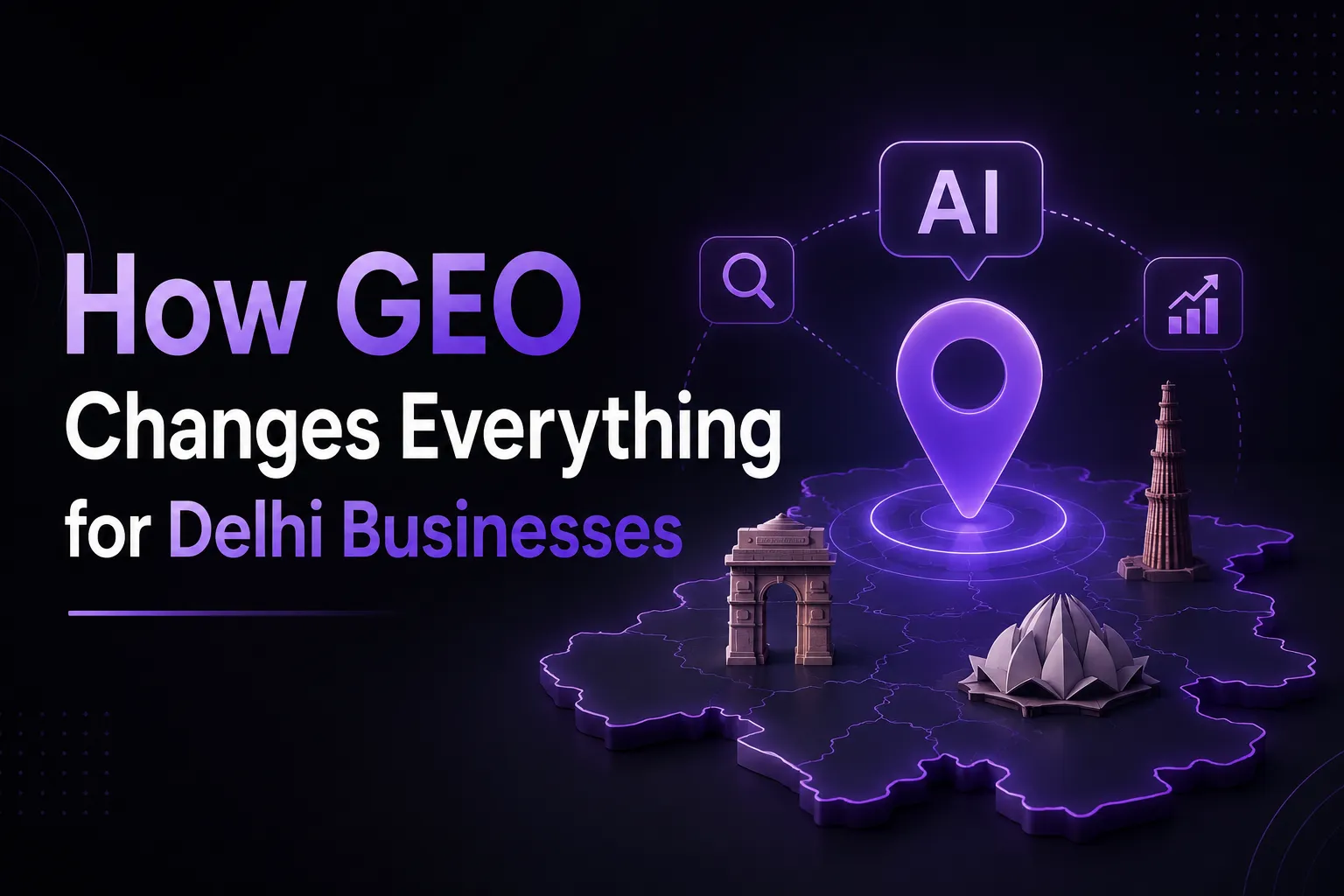
GEO is redefining how Delhi businesses get discovered online, shifting visibility away from traditional blue-link rankings and toward AI-generated answers on platforms like ChatGPT, Google AI Overviews, Perplexity, and Gemini. If your business isn't structured for these generative engines, you're invisible to a growing share of your customers regardless of how well you rank on classic Google search. This shift matters more for Delhi businesses than most, because the city's hyper-competitive markets, from Connaught Place retailers to Gurugram-adjacent tech firms, are already seeing a measurable decline in organic click-through rates as AI answers absorb search intent before a user ever reaches a website.
What Is GEO and Why It's Different in Delhi
Generative Engine Optimisation is the practice of structuring content so AI systems can understand, trust, and cite it when generating answers. Unlike traditional SEO, which optimises for ranking algorithms and keyword matching, this discipline optimises for comprehension by large language models. Generative engines return a synthesized answer, often with only two or three sources cited, sometimes none at all if the model already "knows" the answer from its training data.
This distinction changes the entire game. A business ranking on page one of Google can still lose visibility if an AI engine chooses a competitor's content to build its answer. The competition isn't just for position anymore it's for citation. Delhi businesses that understand this early gain a real advantage, because most local competitors are still pouring budget into outdated keyword-stuffing tactics that generative engines actively ignore.
The underlying technology explains why this happens. Tools like ChatGPT and Perplexity rely on large language models combined with retrieval systems that pull real-time information from the web, a process often called retrieval-augmented generation. These systems don't scan pages the way a traditional crawler does. They break content into semantic chunks, evaluate how well each chunk answers a specific question, and rank sources by clarity, factual density, and demonstrated authority. A page written for human persuasion, full of adjectives and vague promises, often fails this evaluation even if it ranks well on Google.
The Search Behavior Shift in Delhi's Market
Delhi consumers increasingly use conversational queries instead of short keyword searches. A user no longer types "best CA Delhi." They ask an AI assistant, "Which chartered accountant in South Delhi handles GST filing for small businesses and has good reviews?" This query is longer, more specific, and demands a direct answer rather than a list of websites.
Generative engines respond to this behavior by pulling structured, factual, and well-organized content from sources they consider authoritative. Businesses that fail to adapt lose the moment a customer forms intent. This is particularly true in Delhi's service sectors legal consulting, healthcare, education, real estate, and hospitality where trust signals and clear factual answers heavily influence which business gets recommended by an AI system.
This behavioral shift also changes the customer journey itself. A traditional search journey involved multiple clicks: search, compare, visit websites, read reviews, then decide. A conversational AI journey compresses this into a single interaction. The user asks one question and receives a synthesized comparison, often including pricing, location, and service details pulled directly from a handful of sources. If your business isn't one of those sources, you don't just rank lower you disappear from consideration entirely before the customer even opens a browser tab.
Why Traditional SEO Alone No Longer Works in Delhi
Traditional SEO practices backlink building, meta tag optimization, keyword density still hold value, but they no longer guarantee visibility inside AI-generated answers. Generative engines prioritize different signals entirely. They favor content that answers questions directly, uses clear structure, and demonstrates verifiable expertise.
This doesn't mean SEO is dead. It means SEO has expanded. A website now needs to satisfy two audiences simultaneously: search engine crawlers and AI language models. Each has different comprehension mechanisms, but both reward clarity, factual accuracy, and well-organized information architecture. A page that once ranked purely on backlink volume can now lose citation opportunities to a newer, less authoritative domain simply because that domain answers the question more directly.
Here's what generative engines evaluate differently from traditional search algorithms:
- Content structure: Clear headings, direct answers, and logical hierarchy matter more than keyword frequency.
- Source credibility: AI models weigh domain authority, author expertise, and citation patterns from other reputable sources.
- Factual density: Content packed with verifiable facts, statistics, and specifics gets cited more often than vague, promotional language.
- Semantic relevance: Engines look for topic coverage and related entities, not exact-match keywords.
- Freshness and accuracy: Outdated or contradictory information gets filtered out during answer generation.
How Generative Engines Choose What to Cite
AI systems don't randomly select sources. They evaluate content against a set of comprehension and trust criteria before including it in a generated response. A business's website, Google Business Profile, review platforms, and even third-party mentions all contribute to whether an AI engine considers it a reliable source.
Delhi businesses that maintain consistent information across their website, directory listings, and social profiles have a stronger chance of being cited. Inconsistent business hours, mismatched addresses, or outdated service descriptions confuse these systems and reduce citation likelihood. This is why entity consistency making sure your business name, location, services, and contact details match everywhere online has become a foundational requirement rather than an optional detail.
Generative engines also favor content that reads like a direct, standalone answer to a specific question. A paragraph explaining "how much does interior design cost in Delhi" performs better when it gives a real number range with context, rather than a vague statement pushing the reader to "contact us for a quote." The model needs something concrete to extract and summarize. Vague marketing copy simply doesn't give it enough substance to work with, so it moves to the next source instead.
Third-party validation plays a bigger role than most business owners realize. Mentions on independent review platforms, local news coverage, industry directories, and forums like Reddit or Quora carry significant weight because they represent an external, unbiased confirmation of what a business claims about itself. A Delhi restaurant that is only described on its own website looks far less credible to an AI model than one that also appears in food blogger roundups, Zomato reviews, and local publication features.
Core Pillars of an Effective GEO Strategy
Building visibility inside AI-generated answers requires a structured approach. Delhi businesses need to focus on a handful of core areas rather than attempting broad, unfocused optimization across every possible channel. A disciplined GEO strategy treats these pillars as interconnected rather than isolated tasks.
- Answer-first content: Structure every page to answer the primary question within the first few sentences, before adding supporting detail.
- Structured data markup: Use schema.org markup so AI crawlers and search engines can parse business information, services, pricing, and reviews accurately.
- Authoritative bylines: Attach real author credentials to content, since generative engines weigh demonstrated expertise when selecting sources.
- Consistent NAP data: Keep Name, Address, and Phone number identical across Google Business Profile, Justdial, IndiaMART, and your website.
- Topic clusters: Build interconnected content around a core service area instead of isolated, disconnected blog posts.
- Conversational query targeting: Write content addressing full questions people ask AI assistants, not just short keyword phrases.
These pillars work together. A single optimised blog post won't shift visibility on its own. Consistency across the entire digital footprint is what earns citation trust from generative engines. A business that nails structured data but ignores review consistency will still struggle, because AI models cross-reference multiple signals before deciding a source is reliable enough to cite.
Content Formats That Perform Well in AI Answers
Not all content formats carry equal weight when generative engines assemble an answer. Long, narrative-style blog posts without clear structure tend to underperform, even when the information inside them is accurate. AI models struggle to extract a clean, quotable answer from paragraphs that bury the point under storytelling or lengthy context-setting.
FAQ-style sections perform particularly well because they mirror the exact question-and-answer format generative engines use internally. A page that directly states "What does a wedding photographer in Delhi charge per day?" followed by a specific answer gives the model an easy, low-friction extraction point. Comparison tables, numbered lists of services, and clearly labeled pricing sections also perform well for the same reason they present information in a format that requires minimal interpretation.
Case studies and data-backed content carry additional weight. When a business publishes real numbers project timelines, cost breakdowns, before-and-after results generative engines treat this as higher-trust evidence than generic claims. This is one of the reasons original research, even something as simple as a small survey of 50 local customers, can meaningfully boost a business's citation potential over time.
Practical Steps Delhi Businesses Can Take Right Now
Small and mid-sized businesses in Delhi often assume that implementing GEO requires a large technical team or enterprise-level budget. That's not accurate. Most of the foundational work can start with existing content and a clear content audit.
Start by identifying the ten most common questions your customers ask before making a purchase decision. Write direct, factual answers to each one, using real numbers, timelines, and specifics wherever possible. Avoid vague marketing language like "industry-leading" or "best-in-class," since generative engines treat unverifiable claims as low-trust content and typically exclude them from generated answers.
Next, audit your business listings across Google Business Profile, Justdial, Sulekha, and any relevant Delhi-specific directories. Correct any mismatched information immediately. Then add structured data markup to your website's service pages, pricing pages, and FAQ sections. This single technical step significantly improves how accurately AI crawlers interpret your content.
Finally, review your existing blog content and identify pieces that bury the answer under unnecessary introductions. Rewrite these to lead with the direct answer, following the BLUF principle bottom line up front. This single change often produces the fastest visible improvement in how generative engines interpret and cite a page.
Beyond these immediate fixes, build a recurring content calendar centered on real customer questions rather than generic industry topics. Track which questions customers actually ask during sales calls, support chats, and consultations, then turn each one into a dedicated, answer-first page. Over time, this creates a comprehensive knowledge base that generative engines can pull from repeatedly, rather than a scattered collection of loosely related blog posts.
Industries in Delhi Seeing the Biggest Impact
Not every industry experiences this shift equally. Certain sectors in Delhi are already seeing measurable changes in how customers discover and choose service providers through AI-driven answers.
Healthcare and legal services see heavy AI-assisted research before a customer books a consultation. Real estate buyers increasingly ask AI assistants to compare localities, price trends, and builder reputations before contacting an agent. Education consultancies and coaching institutes face AI-generated comparisons of course quality, fees, and placement records. Hospitality and restaurant businesses are affected by AI-curated recommendations that pull from review platforms and structured menu data.
Across these sectors, one pattern repeats: businesses with clear, factual, well-structured online information get cited more often, while businesses relying purely on brand reputation or word-of-mouth lose visibility inside AI-generated recommendations. This makes structured content a competitive necessity rather than a nice-to-have addition.
Retail and e-commerce businesses in Delhi face a slightly different challenge. Product-based queries often pull from marketplaces like Amazon and Flipkart rather than individual brand websites, which means smaller retailers need to focus heavily on differentiated, expert-level content buying guides, comparison articles, and detailed specifications to earn citation for research-stage queries even if the actual purchase happens elsewhere.
Measuring Success Beyond Traditional Rankings
SEO Services in Delhi metrics like keyword rankings and organic traffic still matter, but they don't fully capture visibility inside generative engines. Businesses need new ways to track whether AI systems are citing their content.
Monitoring brand mentions across AI platforms, tracking referral traffic from AI-powered search tools, and periodically testing common customer questions directly inside ChatGPT, Perplexity, or Google's AI Overview reveal whether a business appears in generated answers. This manual testing process, while not scalable long-term, currently offers the clearest signal of GEO performance for most Delhi businesses without access to enterprise-level AI visibility tools.
I'm Vipul Rajput, and having spent over eight years working across 100+ digital marketing projects backed by certifications from SEMrush, HubSpot, and Google Analytics I've watched search behavior evolve from keyword-driven queries to conversational, answer-seeking interactions. Businesses that adapt their content structure now will hold a meaningful advantage over the next two to three years, while those that delay risk losing visibility precisely when customer intent is highest.
Beyond manual testing, businesses should track referral traffic sources in their analytics dashboards, watching specifically for visits originating from AI platforms rather than standard search engines. A rising number of these referrals, even if small initially, signals that content strategy is moving in the right direction. Combining this with periodic brand-mention audits gives a fuller picture than relying on keyword rankings alone.
Common Mistakes Delhi Businesses Make With AI Visibility
Many businesses approach this shift with the wrong mindset, treating GEO as a minor content tweak rather than a structural change. This leads to several recurring mistakes that limit results.
Businesses often stuff pages with keywords instead of writing genuinely useful, question-answering content. They ignore structured data markup entirely, leaving AI crawlers to guess at business details. They maintain inconsistent information across directories, confusing both search engines and generative models. They also write vague, promotional copy instead of specific, verifiable claims a habit that generative engines actively filter out during answer synthesis.
Another common mistake is treating website content as a one-time project rather than an ongoing practice. Businesses publish a batch of pages, then leave them untouched for years. Generative engines favor fresh, regularly updated content, especially for topics like pricing, service availability, and location-specific information that naturally change over time. A pricing page last updated three years ago sends a weak trust signal, even if the numbers happen to still be accurate.
Avoiding these mistakes doesn't require a complete website overhaul. It requires a disciplined content audit and a commitment to clarity over promotional language. As a Freelance SEO expert in Delhi, the most common gap I see is businesses treating their website as a digital brochure instead of a structured knowledge base that both humans and AI systems can parse accurately.
The Long-Term Business Case for Adapting Early
Businesses that start adapting to GEO early build a compounding advantage. Once a generative engine consistently cites a business as a trusted source for a specific query, that citation pattern tends to persist, since AI models favor sources with a demonstrated history of accuracy and relevance. Late adopters face a steeper climb, entering a landscape where competitors have already established citation trust.
Delhi's business environment is saturated with competition across nearly every service category. This saturation makes early adaptation even more valuable, since the gap between AI-optimised and non-optimised competitors will only widen as more customers shift their research behavior toward conversational AI tools instead of traditional search engines.
The businesses winning this transition aren't necessarily the largest or best-funded. They're the ones structuring their content clearly, maintaining consistent information across platforms, and answering real customer questions with specific, factual detail. This levels the playing field in ways traditional SEO, with its emphasis on backlink volume and domain age, never fully allowed. A three-person consultancy in Lajpat Nagar with well-structured, factual content can realistically out-cite a much larger competitor whose content remains vague and promotional.
Building a Sustainable Process, Not a One-Time Fix
Sustainable visibility inside generative engines depends on treating content as a living asset rather than a static deliverable. This means assigning ownership internally someone responsible for reviewing top customer questions quarterly, updating pricing and service pages, and auditing directory listings for consistency.
It also means resisting the temptation to chase every new AI platform individually. The core principles remain consistent across ChatGPT, Perplexity, Gemini, and Google's AI Overviews: clear structure, factual accuracy, consistent entity information, and genuine expertise. Businesses that build content around these principles position themselves well across the entire generative search landscape, rather than optimising narrowly for a single platform that may lose relevance within a year or two.
Final Takeaway
GEO isn't a temporary trend it's a fundamental shift in how customers discover, evaluate, and choose businesses in Delhi's competitive market. The businesses that restructure their content now, focusing on direct answers, factual accuracy, and consistent information across platforms, will secure visibility inside AI-generated recommendations long before their competitors catch up. Ignoring this shift doesn't just mean missing a marketing trend; it means becoming invisible at the exact moment a customer is ready to make a decision. Start small, stay consistent, and treat GEO as an ongoing practice rather than a one-time project, because the businesses that build this habit today will be the ones customers find tomorrow.