Why Your Delhi Website Is Not Ranking on Google
Your website is not ranking on Google in Delhi for five specific reasons: broken technical foundations, thin content, a weak backlink profile, missing local SEO signals, and strategies that ignore how Google's algorithm has changed. Google compares your pages against thousands of rivals every second, so a single weak area is enough to push you off page one, no matter how strong your product is. The sections below unpack each cause and show the exact fix.
Technical Gaps Explain Why A Website Is Not Ranking On Google In Delhi
A page that Google cannot crawl or render properly never gets a fair shot at ranking, regardless of how good the business behind it is. Many Delhi companies invest in a visually polished website while ignoring the technical layer that search engines actually read.
Page speed sits at the top of the list. Core Web Vitals, Google's set of loading, interactivity, and stability metrics, feed directly into ranking calculations. A page that takes over three seconds to load pushes visitors away before they even see your offer, and Google's crawler registers that abandonment as a quality signal against you.
Mobile experience carries equal weight. Google indexes and ranks primarily using the mobile version of a site. A layout that breaks on smaller screens, buttons that overlap text, or menus that fail to open on tap all damage rankings directly. With smartphone usage extremely high across Delhi, a broken mobile experience shuts out a large share of searchers before they ever reach your content.
In most audits, a combination of these small faults, rather than one dramatic error, explains why a website is not ranking on Google in Delhi despite reasonable effort elsewhere. A handful of smaller technical faults compound these problems:
- Duplicate or missing meta titles and descriptions
- Canonical tags applied incorrectly, confusing which page should rank
- No sitemap submitted inside Google Search Console
- Robots.txt rules that accidentally block important pages
Running an audit with Google Search Console, Screaming Frog, or SEMrush typically surfaces these faults within hours. Fixing them will not guarantee an instant ranking jump, but it clears the runway Google needs to evaluate your pages fairly.
Hosting quality deserves its own mention. Budget shared hosting, common among small Delhi businesses, buckles under traffic spikes and slows page delivery. Moving to a dedicated server or a content delivery network shortens load time noticeably and gives Google's crawler a smoother pass through your site, which builds trust that compounds into better rankings over time.
Indexing status is worth checking directly rather than assuming it is fine. A leftover "noindex" tag from a development phase, or a misconfigured setting inside a CMS like WordPress, can quietly remove pages from search entirely. The Coverage report inside Google Search Console shows exactly which URLs are indexed and which are excluded, and this single check often reveals the real reason a site has stalled despite months of publishing.
Weak Content Keeps Your Pages Out of Search Results
Content quality ranks as the second major cause of stalled visibility. Google's emphasis on E-E-A-T, short for Experience, Expertise, Authoritativeness, and Trustworthiness, rewards pages that genuinely resolve a searcher's question rather than skim the surface.
Thin pages rarely compete. A 250-word service page has little chance against a well-researched 1,500-word competitor targeting the same term, because Google directly compares depth and usefulness across every page chasing that keyword.
Keyword stuffing, once a common tactic, now works against you. Google's language models, built on systems like BERT and MUM, interpret meaning and intent rather than counting exact phrase repetitions. Writing for the reader first produces stronger results than writing for an algorithm that has already moved past simple keyword matching.
Duplicate text, whether copied from another site or repeated across your own pages, triggers a ranking penalty because Google typically keeps only one version indexed, and it is rarely the copy that published second.
Weak content is often the quiet reason a website is not ranking on Google in Delhi even when the technical foundation is solid, because Google simply has nothing substantial to rank. Search intent should guide every page. A visitor researching a service wants a direct answer, pricing context, and proof the business can deliver, not filler language dressed up as marketing copy. Clear headings, short paragraphs, and direct answers to specific questions help both the reader and Google's crawler process the page efficiently.
Google favors pages updated with current, accurate information over pages published once and forgotten. A pricing table from two years ago, or a process description the business no longer follows, signals staleness to both readers and search systems. A quarterly content review keeps information accurate and gives Google a reason to revisit and re-evaluate the page.
Competitive industries demand deeper content than niche ones. A Delhi law firm targeting "property lawyer Delhi" faces dozens of established competitors, so a thin service page stands little chance. Thorough content that answers adjacent questions, includes real examples, and explains the process in plain language keeps visitors on the page longer, and that engagement itself sends a positive signal back to Google.
A Thin Backlink Profile Limits Authority
Backlinks remain one of the strongest trust signals Google uses to judge a site. Many businesses lose ground here simply because competitors have accumulated more relevant, high-quality links over time.
Each backlink functions like a vote from another website. A single link from a respected, relevant source outweighs dozens of links from low-quality directories, and links from flagged or spammy domains can actively hurt a site through algorithmic devaluation or a manual action.
Building authority the right way means guest contributions to relevant industry publications, mentions from local business associations, listings in trusted Indian directories, and content strong enough that other sites want to reference it on their own. Paid or automated link schemes violate Google's Webmaster Guidelines and often cause penalties that take months to reverse.
Authority accumulates gradually. A competitor who has earned links consistently for several years holds a natural advantage that a newer site can only close through deliberate, sustained outreach.
Studying competitor backlinks offers a practical starting point. Tools such as SEMrush or Ahrefs reveal which sites link to top performers in your niche, giving a realistic map of achievable opportunities. Reaching out to those same publishers with genuinely useful material converts far better than blanket outreach that ignores relevance.
Removing bad links matters as much as earning good ones. Periodically auditing your backlink profile uncovers toxic links from spam sites or repurposed expired domains, and disavowing them through Google Search Console protects your site from guilt by association.
A thin link profile is one of the least visible reasons a website is not ranking on Google in Delhi, because it does not show up as an obvious error the way a broken page or a slow load time does. Business owners often check every technical box and still wonder why competitors outrank them, without realizing the gap sits entirely in accumulated authority rather than on-page factors.
Local SEO Signals Decide Why A Website Is Not Ranking On Google In Delhi For Nearby Searches
Delhi businesses face an extra layer of complexity, because Google uses location signals to decide who appears in the local map pack, a separate system from standard organic results.
An incomplete or unverified Google Business Profile is one of the most overlooked local ranking blockers. Businesses missing accurate categories, current hours, photos, or genuine reviews lose visibility in the map pack, which often sits above organic listings for service-related searches.
Inconsistent business details across the web quietly undermine local rankings too. When your business name, address, and phone number differ across your website, Google Business Profile, and directories like Justdial, Google struggles to confirm the business is legitimate and accurately located, an issue known as NAP inconsistency.
Local visibility also depends on a few supporting elements:
- Landing pages built around specific Delhi neighborhoods or service zones
- Real customer reviews collected on an ongoing basis, not in a single push
- Citations from directories relevant to the Indian market
- Schema markup that states your business type, location, and service area clearly
Businesses that skip SEO Services in Delhi often perform well for broad national terms while staying invisible to the customers searching nearby, right when purchase intent is highest. For a service-based business, this gap is frequently the exact answer to why a website is not ranking on Google in Delhi for the searches that matter most: the ones from people ready to buy today.
Proximity shapes "near me" results directly. A business in Connaught Place tends to surface more often for searchers in that area than an identical business in Dwarka. This is exactly why some companies rank citywide for general terms yet stay buried for neighborhood-specific searches. Building separate pages for each service area, instead of relying on one generic contact page, gives Google a much clearer picture of where a business genuinely operates.
Outdated Tactics Fail Against Current Algorithm Standards
Google refreshes its algorithm several times a year, and strategies that worked three or four years ago often stop working, sometimes actively causing a drop.
Core Updates and Helpful Content Updates now favor material built for real readers over material built to game search engines. Sites leaning on outdated moves, such as excessive keyword density, exact-match anchor text link building, or unedited AI-generated pages with no factual review, tend to see sharp declines once these updates roll out.
Search behavior has shifted toward full, conversational questions rather than short keyword fragments, driven partly by voice search. Sites optimized only for clipped, short-tail phrases miss a growing share of traffic that now searches in natural sentences.
Staying current means following official Google Search Central announcements, watching ranking movement through analytics, and adjusting strategy ahead of time rather than scrambling after a drop. SEO functions as an ongoing practice, not a project with a finish line.
Business owners often blame a single update for a traffic drop, when the real explanation is usually a slow buildup of outdated practices that the update simply exposed all at once. Treating each update as a diagnostic checkpoint, rather than a random penalty, leads to sharper long-term decisions.
This is also where many businesses first search for why a website is not ranking on Google in Delhi, right after a sudden drop coincides with a known algorithm rollout. The timing feels like cause and effect, but the update usually just removed the tolerance search engines previously extended to weaker practices, rather than introducing an entirely new requirement overnight.
Answers to Common Ranking Questions
A few questions come up repeatedly once business owners understand what is actually happening behind the scenes.
How long does recovery take once these issues are fixed? Most sites show measurable movement within eight to twelve weeks, though crowded fields like real estate, education, or legal services can take longer since established players already hold strong positions.
Does running paid ads fix an organic ranking problem? No. Google Ads and organic rankings run on entirely separate systems. Paid campaigns bring immediate visitors, but they do nothing to shift unpaid, organic placement.
Can a site rank with zero backlinks? Only in extremely low-competition, hyper-local situations. For most commercial terms in a market as crowded as Delhi, a reasonable backlink profile is necessary to compete with businesses already holding page-one positions.
A Practical Path to Higher Rankings
Once the root causes are clear, fixing stalled rankings becomes a structured process instead of guesswork. Trying to fix everything simultaneously usually spreads effort too thin, so working through priorities in order produces better results:
- Complete a full technical audit covering speed, mobile usability, crawl errors, and indexing status
- Rewrite thin or outdated pages with genuine depth, clear structure, and direct answers to real questions
- Build a natural backlink profile through guest content, partnerships, and relevant industry mentions
- Verify your Google Business Profile and keep business details consistent everywhere online
- Add neighborhood-specific content and schema markup for each Delhi service area
- Review performance monthly through Google Analytics and Google Search Console rather than reacting daily
These fixes reinforce each other rather than working in isolation. A fast, technically sound site with weak content still underperforms, just as strong content on a slow, poorly structured site falls short. Sustained, integrated effort across all five areas produces visible ranking gains within three to six months in most competitive Delhi categories.
Measuring progress correctly matters just as much as making the changes. Record a baseline of current rankings, organic traffic, and conversions before starting, then review the numbers monthly instead of daily to avoid reacting to normal short-term noise.
Business owners frequently ask which of these five areas to fix first when budget or time is limited. Technical fixes usually come first because they are the fastest to complete and remove barriers that block every other effort from working. Content and local SEO follow closely, since both start generating impact within weeks. Backlink building takes the longest to show results, so starting it early, even in parallel with other fixes, prevents it from becoming the final bottleneck once everything else is in place. Businesses that follow this order of priority stop wondering why their website is not ranking on Google in Delhi and start seeing steady, compounding improvement instead.
Final Word
Technical gaps, thin content, a weak backlink profile, missing local signals, and outdated tactics each chip away at a site's visibility on their own, and together they explain almost every stalled ranking case in Delhi's competitive market. Addressing these five areas systematically, rather than chasing one quick fix, is what separates sites that recover from those stuck on page two indefinitely. Start with a technical audit, strengthen the content, and build genuine local authority step by step, and the results will follow. That steady approach is the real answer to why your website is not ranking on Google in Delhi, and it is the same approach that turns a stalled site into one that grows month after month.
About the Author
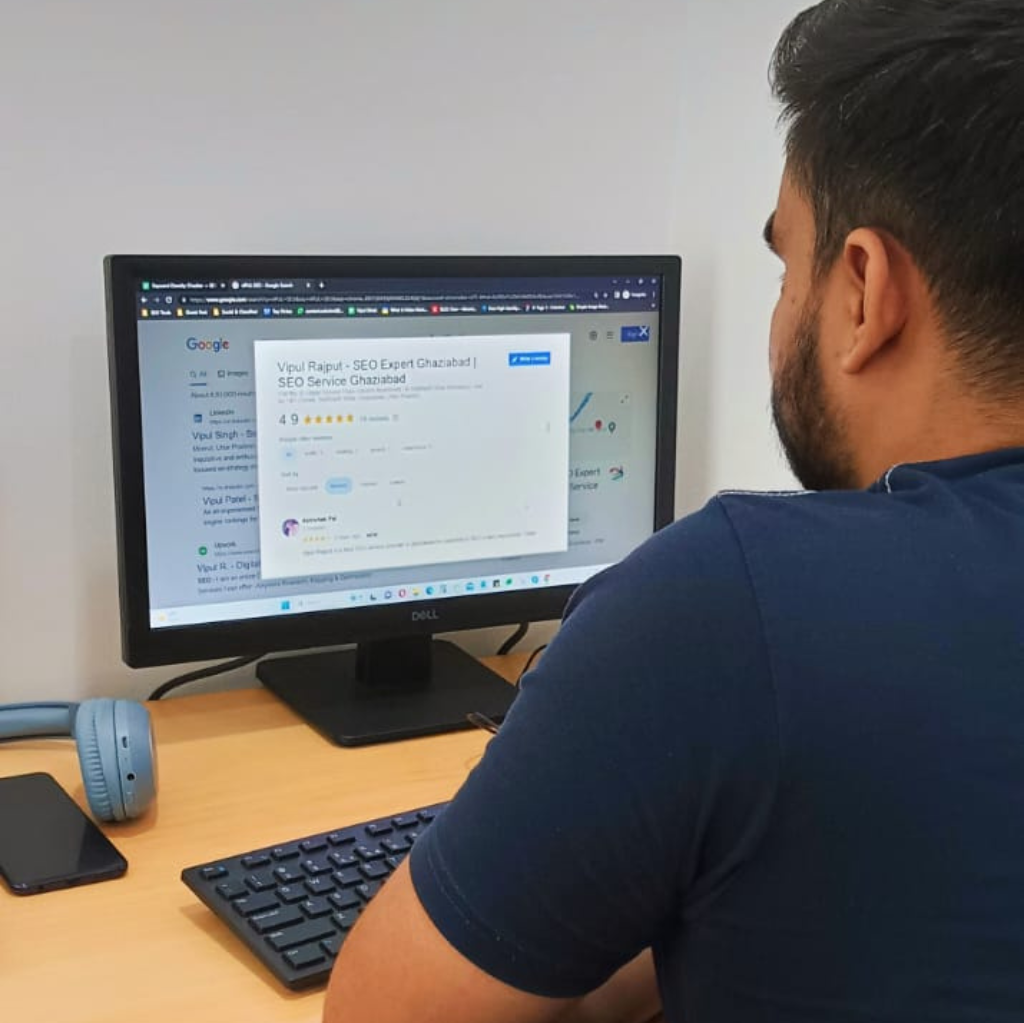
This guide comes from Vipul Rajput, an SEO expert with more than 8 years of hands-on experience improving search visibility for businesses across India. Vipul has delivered results on over 100 projects spanning e-commerce, local services, and B2B websites, and holds certifications from SEMrush, HubSpot, and Google Analytics. Widely regarded as the best SEO expert in Delhi, Vipul relies on practical, guideline-compliant strategies rather than shortcuts that risk long-term penalties.