Why Most Delhi Businesses Fail at SEO
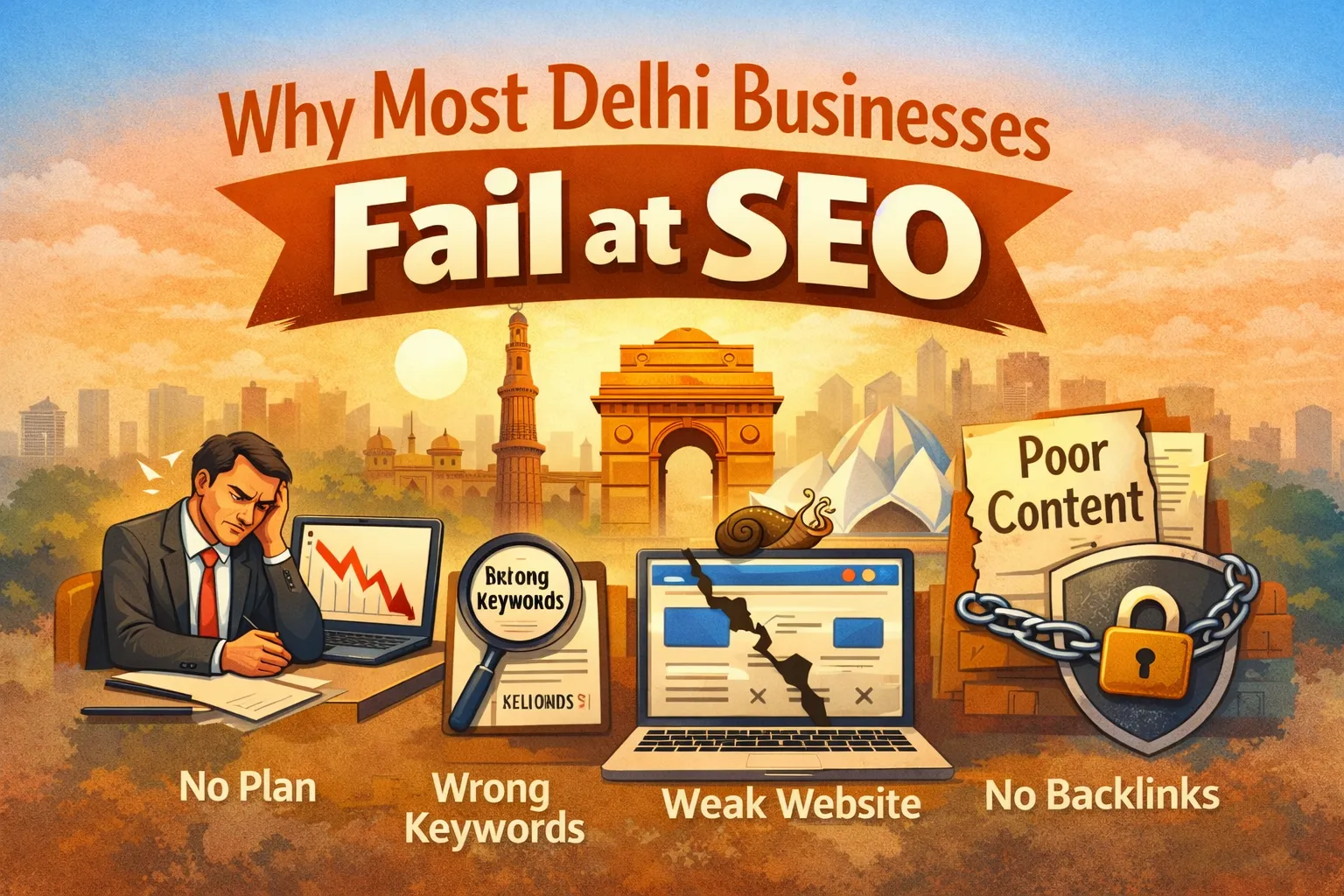
Most Delhi businesses fail at SEO because they chase quick rankings instead of building sustainable search visibility, and they abandon strategies before the algorithm has time to reward consistent effort. This single pattern explains nearly every failed SEO campaign I've reviewed over the years. As an SEO Expert in Delhi, I've audited hundreds of websites, and the failures rarely come from a lack of effort; they come from misplaced priorities, unrealistic timelines, and strategies borrowed from generic templates that ignore how competitive Delhi's digital market actually is.
Businesses Expect Overnight Results in Delhi
The biggest reason SEO fails in Delhi is impatience. Business owners invest in SEO expecting first-page rankings within weeks, and when results don't appear immediately, they either switch strategies or abandon the effort entirely. Search engines simply don't work this way.
Google needs time to crawl, index, and evaluate a website before trusting it enough to rank it competitively. This process, often called the sandbox effect, typically takes three to six months for new or recently optimized websites, especially in saturated markets like Delhi where thousands of businesses compete for the same commercial keywords.
This impatience creates a destructive cycle. A business starts an SEO campaign, sees no visible movement in month one, panics, and either fires their SEO provider or shifts the entire budget to paid ads. Six months later, a competitor who stayed consistent captures the organic rankings this business gave up on. The pattern repeats across countless businesses because short-term thinking dominates decision-making in fast-paced markets.
They Treat SEO as a One-Time Project, Not an Ongoing Process
Many Delhi businesses approach SEO like a website redesign: something you do once and forget about. They optimize their site, publish a handful of blog posts, and assume the work is complete. Search engines, however, reward continuous relevance, not one-time effort.
Google's algorithm updates constantly, and competitors are simultaneously publishing new content, earning fresh backlinks, and improving their own technical performance. A website that stops evolving eventually falls behind, even if it ranked well initially. This is particularly true in Delhi's fast-moving sectors like real estate, education, and e-commerce, where competitor activity never really slows down.
Sustainable rankings require ongoing content updates, ongoing link building, ongoing technical maintenance, and ongoing performance tracking. Businesses that treat SEO as a checklist item rather than a continuous discipline almost always see their rankings decline within a year, regardless of how strong their initial results were.
Poor Website Foundations Undermine Every SEO Effort in Delhi
A significant percentage of Delhi businesses invest heavily in content and backlinks while completely neglecting their website's technical foundation. Slow loading speeds, broken mobile responsiveness, and poor site architecture quietly sabotage even the best content strategy.
Google's Core Web Vitals directly influence rankings, measuring factors like page load speed, visual stability, and interactivity. A beautifully written blog post means little if the page takes eight seconds to load on a mobile network, which remains common across parts of Delhi NCR where connectivity varies significantly by area and provider.
Technical issues like duplicate content, missing meta tags, broken internal links, and improper URL structures also quietly limit a website's ranking potential. Many business owners never audit these technical elements because they aren't visible the way content or design is, yet they often matter more than any single blog post or backlink.
A few technical foundations businesses frequently overlook:
- Mobile page speed and Core Web Vitals performance
- Proper XML sitemap and robots.txt configuration
- Clean URL structures without unnecessary parameters
- Structured data markup for rich search results
- SSL certification and secure site architecture
They Target the Wrong Keywords Entirely
Ranking for high-volume, generic keywords feels appealing, but it's often the wrong strategy for most Delhi businesses. Terms like "best restaurant Delhi" or "digital marketing agency" carry enormous competition, and smaller businesses waste months, sometimes years, trying to rank for terms dominated by established players with far larger budgets.
Instead, businesses should target keywords that match actual buyer intent, even if search volume appears smaller. A boutique law firm in Delhi has a far better chance ranking for "property dispute lawyer in Saket" than for "best lawyer Delhi," and the traffic it does capture converts at a significantly higher rate because it matches specific, high-intent searches.
This keyword mismatch happens because businesses focus on vanity metrics like search volume instead of realistic ranking potential and conversion likelihood. A smaller, well-targeted keyword strategy consistently outperforms broad, unrealistic keyword targets, especially for businesses with limited SEO budgets competing in Delhi's crowded digital landscape.
Content Gets Created Without Strategy or Purpose
Delhi businesses often publish content simply because they've heard content marketing helps SEO, without any clear strategy behind what they're creating. Random blog posts, disconnected from actual customer search behavior, rarely move the needle regardless of how well-written they are.
Effective SEO content starts with genuine keyword research and an understanding of what questions potential customers are actually asking during their buying journey. Content created without this research often targets topics nobody searches for, resulting in wasted effort that never generates meaningful organic traffic.
Additionally, many businesses publish thin, generic content that doesn't provide real value or unique insight. Search engines increasingly reward depth, expertise, and originality through frameworks like E-E-A-T, which evaluates experience, expertise, authoritativeness, and trustworthiness. Content that simply repeats what's already available elsewhere online rarely ranks competitively, no matter how frequently it's published.
They Ignore Local SEO Despite Serving Local Customers
A surprising number of Delhi businesses that primarily serve local customers completely neglect local SEO fundamentals. They focus entirely on ranking nationally while ignoring their Google Business Profile, local citations, and neighborhood-specific keyword targeting.
This mistake costs businesses enormous visibility in local search results, particularly the Local Pack that appears for "near me" searches. A gym in Rajouri Garden competing only for broad national keywords misses the customers actually searching for gyms specifically in their area, who represent far higher conversion potential than generic national traffic.
Local SEO requires distinct strategies compared to general SEO, including consistent NAP information, location-specific content, and active review management. Businesses that ignore this distinction essentially compete in the wrong arena, chasing visibility that doesn't align with how their actual customers search.
Backlink Strategies Rely on Quantity Over Quality
Many businesses still believe that acquiring as many backlinks as possible automatically improves rankings. This outdated approach often backfires, especially when links come from low-quality, spammy, or irrelevant websites that search engines increasingly flag as manipulative.
Google's algorithm evaluates link quality far more than link quantity. A single backlink from a reputable, relevant, high-authority website provides more ranking value than hundreds of links from low-quality directories or link farms. Businesses that chase volume over relevance often see their rankings stagnate or even decline after Google devalues or penalizes suspicious link patterns.
Building genuine backlinks requires real relationship building, guest contributions to relevant publications, and creating content valuable enough that other websites naturally want to reference it. This process takes significantly more effort than mass link submissions, which is precisely why so many Delhi businesses avoid it in favor of shortcuts that ultimately damage their long-term SEO performance.
Businesses Don't Track the Right Metrics in Delhi
Without proper tracking, businesses have no way of knowing whether their SEO efforts are actually working. Many Delhi businesses either don't track performance at all or focus exclusively on vanity metrics like overall website traffic, ignoring conversion-focused data that actually reflects business impact.
Tools like Google Analytics and Google Search Console provide essential insights into which keywords drive traffic, which pages convert visitors into customers, and where technical issues might be limiting performance. Businesses that never review this data continue investing in strategies that aren't working simply because they lack visibility into what's actually happening.
Effective SEO measurement goes beyond rankings and traffic numbers. It requires tracking metrics like organic conversion rate, cost per acquisition compared to paid channels, and customer lifetime value from organic traffic sources. Without this deeper analysis, businesses can't make informed decisions about where to invest their SEO budget most effectively.
They Hire the Wrong SEO Partners
Delhi's competitive market has created a flood of low-cost SEO providers promising unrealistic results, guaranteed first-page rankings within weeks, often for prices that make genuine, ethical SEO work financially impossible. Businesses drawn to these cheap promises frequently end up with damaged websites rather than improved rankings.
These providers often rely on outdated or manipulative tactics like keyword stuffing, private blog networks, or automated link building, all of which violate Google's Webmaster Guidelines and can result in manual penalties that take months to recover from. The short-term savings rarely justify the long-term damage these practices cause.
Choosing an experienced, credentialed SEO partner matters significantly. During my career spanning over 8 years and 100+ completed projects, holding certifications from SEMrush, HubSpot, and Google Analytics, I've repeatedly seen businesses recover from penalty situations caused by exactly these kinds of shortcuts, often paying far more to fix the damage than they originally saved by choosing the cheapest available option.
Internal Misalignment Between Marketing and Business Goals
SEO often fails not because of technical or strategic mistakes, but because of internal misalignment within the business itself. Marketing teams pursue rankings and traffic while sales teams focus on immediate conversions, and without clear communication, these efforts work against each other rather than together.
A website might successfully rank for valuable keywords, but if the sales team doesn't understand how to nurture organic leads differently from referral or paid leads, conversion rates suffer regardless of how strong the SEO performance actually is. This disconnect wastes the value that successful SEO efforts create.
Businesses that succeed long-term treat SEO as an integrated part of their overall growth strategy, not an isolated marketing task. This requires ongoing collaboration between content teams, technical teams, and sales teams to ensure organic traffic actually converts into measurable business results.
What Successful Delhi Businesses Do Differently
Businesses that succeed with SEO in Delhi share common characteristics regardless of industry. They commit to realistic timelines, understanding that meaningful results take months, not weeks. They invest in technical foundations before scaling content production, ensuring their website can actually support the traffic they're working to attract.
They also prioritize quality over shortcuts at every stage, whether that's content creation, link building, or choosing an SEO partner. This patience and discipline consistently separates businesses that build lasting organic visibility from those that cycle through failed campaigns year after year.
A few practical shifts that consistently improve SEO outcomes:
- Setting realistic 6 to 12 month timelines instead of expecting immediate results
- Fixing technical website issues before scaling content production
- Targeting specific, intent-driven keywords instead of broad generic terms
- Tracking conversion metrics, not just traffic and ranking positions
Building a Strategy That Actually Works
SEO failure in Delhi isn't usually about lacking effort or budget; it's about misaligned expectations, weak foundations, and shortcuts that damage long-term potential. Businesses that understand this shift their approach from chasing quick wins to building sustainable, compounding organic growth.
The path forward requires patience, technical accuracy, genuine content value, and consistent measurement of what's actually working. Working with a knowledgeable SEO Expert in Delhi who prioritizes sustainable strategy over unrealistic promises makes this process significantly more manageable, helping businesses avoid the common mistakes that continue to derail SEO efforts across this competitive market.